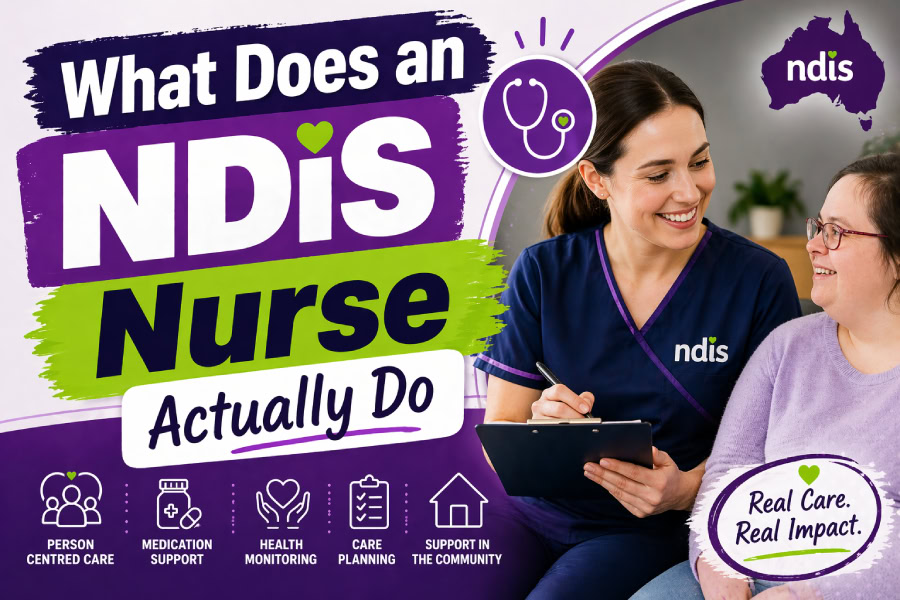
People often hear “community nurse” and assume it is somewhere between a support worker and a GP. It is neither. Community nurses are registered nurses (RN) or enrolled nurses (EN) who deliver clinical care in your home. Here is what that actually looks like.
Table of Contents
ToggleScope of Practice
Community nurses can do most of what a nurse in a hospital or clinic does, within the limits of what can be delivered safely in a home setting. That includes:
Wound care. Assessment, cleaning, dressing, documentation, and photographing for ongoing tracking. Simple wounds and complex wounds (pressure injuries, ulcers, surgical wounds).
Catheter management. Insertion, removal, routine changes, bladder washouts, and troubleshooting blocks or infections.
PEG feed management. Tube checks, site care, feed setup, troubleshooting, and skin assessments.
Stoma care. Bag changes, skin management, accessory support, and troubleshooting.
Medication administration. Subcutaneous injections (insulin, anticoagulants, hormone treatments), Webster pack supervision, medication reviews, and liaison with your pharmacy.
Bowel care. Enema administration, bowel program management, continence assessments.
Health assessments. Vital signs, weight, skin integrity, falls risk, nutrition screening, and general health monitoring.
Chronic disease review. Regular visits for MS, Parkinsons, motor neurone disease, COPD, heart failure, diabetes.
Hospital-to-home transitions. Managing the gap between hospital discharge and full community recovery.
What They Do Not Do
- Diagnose conditions (that is a GP or specialist)
- Prescribe medications (except in very limited nurse practitioner scenarios)
- Order imaging or major tests
- Personal care (showering, dressing, toileting) — that is a support worker role
How a Nursing Visit Usually Runs
A typical community nursing visit is 30-60 minutes. The nurse:
1. Arrives on time, wearing appropriate PPE
2. Handwashes and sets up clinical workspace
3. Does the planned clinical task (dressing change, catheter, medication, etc.)
4. Takes observations and documents findings
5. Communicates with the participant about what they are doing and why
6. Cleans up, disposes of clinical waste appropriately
7. Reports back to the GP, specialist, or care coordinator as relevant
What Qualifications Do They Have
Registered nurses have a bachelor’s degree in nursing plus registration with AHPRA (Australian Health Practitioner Regulation Agency). Enrolled nurses have a diploma-level qualification and also AHPRA registration. Both are regulated and required to maintain ongoing professional development.
How to Check a Nurse’s Credentials
Every registered or enrolled nurse in Australia is listed on the public AHPRA register. You can search a nurse’s name to verify they are registered and in good standing. A reputable provider will tell you their nurses’ credentials if you ask.
Working with Your GP
Community nurses do not replace your GP. They work alongside them. Typically, the GP provides a care plan or referral, the nurse implements it, and the nurse reports back on progress. Your GP remains the primary decision-maker on your medical care.
Integration with Support
A practical benefit of using the same provider for nursing and support work is that the care plan is shared. At Humility Support Services, our nurses and support workers are on the same team, which means a worker can flag a wound concern and a nurse can be booked in the same day. See our community nursing service page and Community Nursing Brisbane location page for more.
Getting a Nurse Assigned
Call +61 415 868 405 or contact Humility Support Services. Related reading: who needs NDIS community nursing in Brisbane, how to access community nursing faster, and community nursing vs support workers.